
Upaya Social Ventures uses impact‑linked finance to support textile waste enterprises that centre sanitation and waste workers in circular economy models
Source: Upaya Social Ventures
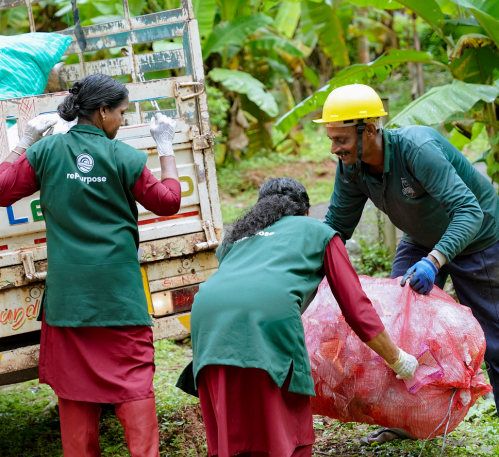
Upaya Social Ventures’ Technical Assistance Facility (TAF) for Textile Waste Management is an integrated financing model designed to support enterprises building circular economy solutions with sanitation and waste workers at the centre. Launched in 2024 with a USD 1.5 million catalytic grant, the facility combines seed capital, tailored technical assistance, and impact-linked incentives across three portfolio enterprises: Green Worms, WeVois Labs, and Saahas Zero Waste.
Each enterprise receives approximately USD 200,000 in seed capital, with full interest waiver linked to predefined impact targets across three dimensions: quality job creation for people in poverty, diversion of post-consumer textile waste from landfill, and financial viability of the textile waste management unit. A further USD 50,000 in non-repayable performance incentives aligns financial returns with social and environmental outcomes.
Over the first two years of implementation, partner enterprises have established textile recovery operations, tested sorting and processing systems, and begun building downstream market relationships. Operational facilities are now active across multiple cities, with early systems for sorting, grading, and recovering post-consumer textile waste in place. Enterprises have also strengthened their ability to track waste flows, workforce outcomes, and recovery pathways, while initiating buyer partnerships across recycling, downcycling, and resale markets. Early ecosystem collaborations are also underway to explore higher-value applications for recovered materials.
Implementation has also surfaced important lessons. Enterprise readiness, particularly leadership commitment and management bandwidth was as important as prior sector experience. Post-consumer textile waste remains highly labour-intensive to process, especially mixed and blended fabrics. And downstream market development is underdeveloped, reinforcing the need for buyer engagement and demand aggregation as core components of future facility design.
Most importantly, the facility demonstrates that impact-linked finance can work in a sector historically dependent on grants – offering a practical, replicable model for tying concessional capital to measurable just transition outcomes across circular value chains.